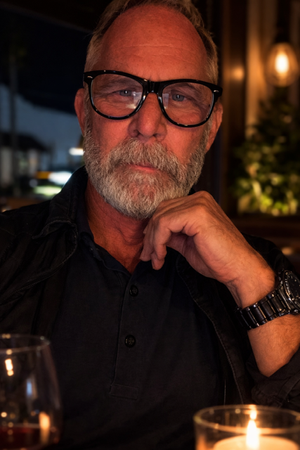
The Warrior Teddy Bear
I don't know how to write this. I'm bawling my eyeballs out just thinking about it. Just the title makes me cry.
It's May 20th, 2026. I'm 67 years old. Walking off the battlefield. Sixty-seven years of trying to force myself to be something I was never meant to be. Something I could never be.
A couple of weeks ago, I learned about two more neurological differences I carry — on top of my dyslexia, which I've known about since sixth grade, and my dysgraphia, which I discovered in 2023. I made peace with the guilt and the shame of those two. And when I did, I started writing the Tumbleweed Diaries.
Last week, to my complete shock, I was watching an interview. These two conditions came up. My jaw hit the floor.
Aphantasia — the inability to voluntarily create mental visual images. When most people think of an object — a house, a face — an image appears in their mind. When they reflect on a memory, it plays out like a film. People with aphantasia don't experience this. Their thinking and imagination carry no pictures. They may use other senses instead — words, feelings, numbers. Research estimates it affects about 2–4% of the population, though many people with the trait never realize they have it.
Anauralia — the absence of voluntary inner auditory experience. A neurological variation in which an individual lacks the capacity for auditory mental imagery — including internal speech, the mental replay of music, or the imagined sound of a voice. Distinct from hearing loss. Not a disorder. A difference in cognitive architecture. Often co-occurs with aphantasia.
I can't begin to tell you what it's like to unravel a whole lifetime — knowing something was wrong, but never having a word for it. Instinctively feeling off. But unable to say why.
I can't tell you how many times, as a young boy, I'd sit at the dinner table — surrounded by love and laughter — and listen to my siblings and parents and family tell their stories. And not be able to remember being there. I spent my whole life standing in front of people I desperately wanted to know. And the moment they turned away, I'd forget their name. Forget what we'd been talking about. I'd see them a week later and not recognize them at all.
That's where the storyteller was born.
I began to tell stories not based on facts, but on feelings and conceptions. I would tell you a story that would convince us both that we'd known each other for years. That we were close. But if you asked me to recall a specific fact — a time, a place, an event that created that closeness — I would start to sweat.
I think most people, when they speak about their lives, are recounting facts. Truths about their experiences. Not me. I instinctively knew I was telling something closer to a lie — though lie feels too harsh. It was more like a polite bridge. A way to connect. You might believe it for a while. But eventually, we both knew to keep a polite distance. Usually initiated by me, before I got caught.
That usually got translated as: Oh, there's PC. He's afraid of commitment.
So. Let this serve as a little forward to the story of the Teddy Bear Warrior.
A small disclaimer: this story goes to some dark places. There is childhood abuse ahead. I wouldn't write it if my parents were still alive. It would break their hearts to know they couldn't protect me. But no parent really can.
Once upon a time, there was a little boy who had a beautiful family and was deeply loved. He had two older sisters and two younger sisters. He was a gentle and kind little boy. His father was a warrior — also a gentle and kind man. His mother was a warrior, as all mothers are, usually fighting on a battlefield nobody sees. They put medals on his father's chest. And tears on his mother's. They were fiercely committed to protecting and providing for their kids. The home was full of love, patience, and understanding.
But most little people need something outside themselves to hold onto. The Little Tumbleweed Warrior was no different. He had a teddy bear that would wait patiently on his pillow each day — there when he came home from his tiny little battlefields. At night, they'd sit under the covers and tell each other stories about the day. The victories. The wounds. His teddy bear had great power and great wisdom. He was a source of comfort and understanding like nothing else in the world.
They went through a lot together.
When the Little Tumbleweed Warrior had to have eye surgery — one of his eyes had begun to wander — he brought his teddy bear to the hospital. For safety. For courage. But a nurse decided it was inappropriate for a stuffed animal to enter the sterile operating room. There was a tug-of-war. The nurse pulled. The arm came off.
Very traumatic.
But in the morning, the teddy bear was bandaged up. Just like I was.
Life went on. The teddy bear supplied comfort. Every night I'd come home, and there he'd be — right where I'd left him, on my pillow, after I'd made my bed that morning. He had real power, that bear. Even as I was getting older. The Tumbleweed Warrior was probably eight or nine.
It was around that time when things began to not add up. Not just for me — I'd sensed for a long time that something was off. But the adults and institutions around me were starting to notice too. I was held back a year. Couldn't quite keep up with my classmates. Nobody had a name for why.
My father was deployed around then — Thailand or Vietnam, I could never quite keep it straight. Before he left, he moved the family to Spokane, Washington. He and I drove cross-country together, just the two of us. We hardly spoke. Not because we didn't love each other. But I had these neurological holdbacks that were a secret not just to me, but to everyone. The science was barely beginning to find a name for dyslexia. Everything else was decades away from being understood.
In hindsight, that drive was just the way it was meant to be. We were doing our best.
I remember when he left. He was a Lieutenant Colonel by then — maybe a full bird Colonel. But he left. He told me to take care of the girls. Take care of your mom. And I, being a good little warrior, told him I would. With the underlying fear that I didn't have what it took. I instinctively knew I was already facing a neurological battlefield that I would walk onto at ten years old and not walk off of until I was sixty-seven.
My father was gone. I was doing the heavy lifting of a boy who could only relate to life through feelings and conceptual storytelling. My teddy bear always understood. He would reassure me that everything would be all right.
We were getting to know our new home — we moved often, being military. Every year and a half or so. I was good at making friends, good at fitting in. I was a little worried about being held back, but nobody here knew my history. It would be fine. At least, that's what my teddy bear told me.
There was a man who lived up the street. I remember riding my bike into his driveway. He had a big radio antenna — fifty feet up in the air on the side of his garage. Very interesting. He coaxed me inside the house. He talked me into taking my clothes off. That was my first sexual experience. The first time that kind of darkness touched me.
That night, under the covers with my teddy bear, I shared what had happened. The fear. The guilt. The shame that had no name yet, but was already heavy. My warrior teddy bear told me to prepare for battle. We laid out the first plans of a battleground that stretched far beyond the beautiful, optimistic childhood I'd had until that moment.
My warrior teddy bear told me: We will be fine. Let's just not get found out. Let's hide our position. No one can know what our battle plan is.
That night, I dug in.
I had no idea the war I was going to fight — with that guilt, that shame, that instinctual knowing that something was off. I had no idea how brave I would have to be. How long it would take. How lonely.
It wasn't long after that when I walked across the street to a neighbor who had a little boy. I told that boy the story of my warrior teddy bear and all he had done for me. But the teddy bear knew my secret. And we both knew he had to go. I couldn't afford the risk of him letting it slip. So I gave him away. He was worn and tattered and had been through more than most. His arm had been sewn back on by a kind nurse. But there was a sense of relief in it. I felt I was doing something honorable — getting my warrior to another small tumbleweed warrior who needed him. And I knew my secret was safe. Even with him gone.
I miss him dearly.
Every day after that, I would wake up alone and walk out the door onto the battlefield of my feelings and my conceptions — but never my truth. Guilt and shame became my armor. I instinctively knew that my feelings weren't facts. And conceptual storytelling became my shield.
Every day I would wake up and fight. I didn't understand why I couldn't remember the family vacation. My cousins' names. Anyone's birthday. I didn't understand why reading was so hard, or why my hands betrayed me when I tried to write. No one knew that when I closed my eyes, I saw only darkness. I couldn't let anyone know that I didn't know the words to any songs. That I couldn't hear music in my mind.
So that was the year of the teddy bear.
That was the year my life changed forever. My ego stepped in, and I became a slave warrior — falling into, as it turns out, a legion of pessimistic, brokenhearted, misunderstood teddy bear warriors.
— Arvid Paul Croonquist, The Tumbleweed Diaries