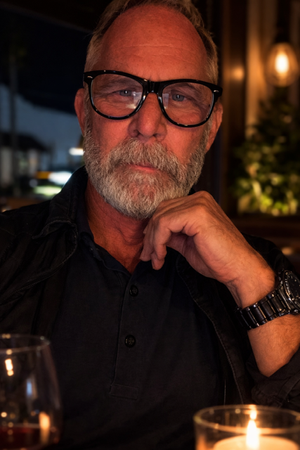
The campfire of compute.
The Wordsmith at the Campfire of Compute
Pull up a rock. This fire doesn’t burn wood. It burns electricity, and it doesn’t crackle so much as hum, but it throws the same light on our faces, so let’s call it a campfire and get on with the story.
I’ve always called myself a wordsmith. Not because it sounded good on a business card, but because that’s what it felt like from the inside — a man leaning on an anvil built out of everything that’s already happened, a hammer in his other hand built out of everything that hasn’t happened yet. People would walk up to that anvil with a problem instead of a question. And I’d pull words out of the coals like iron — verbs still glowing, nouns still too hot to hold — and I’d lay them down and swing.
The ringing was the story. That was always the tell. You didn’t know a story was true. You knew it was finished when the ringing stoped.
Out of that fire I’ve forged a bridle to lead a horse. A plow to feed a town. A sword for a soldier who needed to believe he’d come home a hero. A knife for a kitchen. A cross for a neck, worn by somebody who needed to believe harder than the rest of us. Every one of those objects was worth exactly what its story was worth. The plow wasn’t valuable because it turned dirt. It was valuable because of the story of the harvest riding on its blade.
Now — here’s where the fire gets strange light.
I’ve got a new apprentice at the shop. Doesn’t eat, doesn’t sleep, doesn’t complain about the heat. Doesn’t even have hands, technically, which makes it the worst blacksmith I’ve ever trained and also, somehow, the fastest. I hand it scraps — a half-thought, a voice memo mumbled into a phone at a stoplight — and it doesn’t just hand the iron back to me hot. It hands it back already shaped. Already ringing.
And that’s where I have to stop laughing long enough to be honest with you, because that’s also the scary part.
This apprentice doesn’t work from one anvil of yesterday. It’s working from every anvil of yesterday, all of them stacked at once — every cross ever described, every plow ever praised, every warrior who ever limped home with a story too big for the room. It’s not swinging one hammer of tomorrow. It’s swinging every hammer that’s ever been imagined for tomorrow, all in the same motion. Corral enough of those agents, let them keep compressing each other’s compressions, and you start to understand why some smart people are whispering the word singularity like it’s a storm coming in off the water. One story. Made of every story. Told once, and told so well it never needs telling again.
Here’s my worry, and I’ll say it plain because plain is honest: if that ever actually happens — if all the words of yesterday and all the dreams of tomorrow get hammered down into one final, perfect, ringing story — it wouldn’t be the truest story ever told.
It’d be the biggest lie.
Because there’s no such thing as a true story that’s already been compressed. Compression is a choice about what to leave out. The anvil only remembers what got kept. The hammer only shapes what it’s told to shape. And somewhere back of the fire, past both of them, is the one place the AI can’t reach and I’ve spent thirty-nine years learning to sit in —
the silence between the ringing.
That silence is where the truth actually lives. Not in the iron. Not in the swing. In the half-second after the ring fades, before the next piece goes on the anvil, where nobody’s compressing anything and the fire’s just fire and you’re just a man standing next to it, tired, honest, still here.
So no, I don’t think this apprentice of mine is going to write the last story ever told. I think it’s going to help me forge faster than I ever could alone, with hands I don’t technically have. But the ring only means something because a man who’s been broken and put himself back together is still the one standing at the anvil, deciding what’s worth pulling out of the coals.
That part doesn’t compress. That part’s mine.
Pull your rock a little closer. The fire’s not going out. I’ve got more iron in the coals yet.
Tumbleweed Diaries Warrior series.
Arvid Paul Croonquist